 |
| Zazouse's chicken on Backyard Chickens.com Wins the Worst Chicken Molt Picture
Oh. Oh. It's like the Hans Christen Andersen's children's story, The Emperor's New Clothes. Is anyone going to tell this chicken that she's naked?
It's that time of year when some of our chickens (none of mine, yet, because it's been warm here) are starting to lose their feathers. This picture by Zazouse on Backyard Chickens won the prize for the worst molt.
|

For Women (and Men) who Love Raising Chickens.
Tuesday, October 23, 2012
The Autumn Revolt: The Molt

Cuba: Where Chickens Run Wild in the Streets
 |
| Copyright Mallory on Travel |
Photographer, adventure traveler, and blogger Iain Mallory wrote blog article, Cuba in Black-and-White: A Portrait, about his travels to Cuba. His photographs and accompanying text tell a compelling story of Cuba. Mallory also mentions that chickens run wild in the streets of Cuba. He says that "Women purchase their shopping from small roadside counters, carrying live chickens home, grasped tightly in small but work roughened hands, the birds hanging by their feet."
Friday, October 19, 2012
inmod Egg Chair
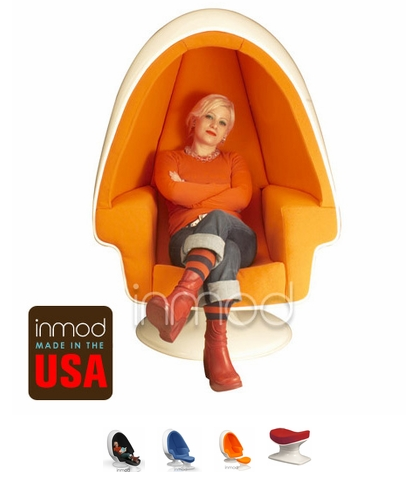
I'm not exactly a modern girl. I like my furnishings to have the patina of love and time. When someone walks into my house, I like nothing more than if they flip off their shoes and sink onto the sofa, plop onto a floor pillow, or twirl contentedly around in the stool at my kitchen bar. Absolutely everyone who walks into my home has license to open up the refrigerator door, pull out a snack or two, and cook up a quick dinner. Perhaps it's my Midwestern roots, but mi casa es su casa hangs intangibly above my every door.
Antique stores, thrift stores, grandma's garages, and friend's attics--I love them all for ferreting out furnishings for my home. The seeking out of great things can be almost addictive in nature. I've found that there's always another great knick-knack to be found behind the next door.
But, as much as I love the old, I also love the new. And, perhaps that's where my "other style" comes in. I can't stand clutter. I love clean lines. Symmetry? Well, how I could not love that? It's so darn easy on the eye.
Which leads me, in my inner interior designer desires, to crave having a home furnished with modern decor. There's something so refreshingly new, sterile, and untouched about it. The lines are simplistic and clean. And, it makes you feel young and contemporary.
I'm torn that way. It must the Libra in me. I love old-fashioned rural living with a wrap-around porch and the sound of an owl hooting me to sleep at night. But, I also believe I could live in the city, in an urban highrise, a loft with sky-high ceilings and furnishings that are simple and clean and like...well, like the inmod's Egg Chair. Just check it out. Can't you just imagine kicking off your shoes after a long day's work and slipping into this egg? And, best yet, you can load up some tunes on iTunes and relax to the sounds of your fav band. Van Morrison, The Animals, or Snow Patrol in the egg? Nothing greets you better after a long day.
If you've ever been to The Standard in downtown Los Angeles and imbibed in a drink on its rooftop, you know what I mean. (And, if you haven't, I highly recommend it.) The Standard's decor is very modern, very clean, so L.A. If you can pull yourself away from the bar and The Standard's mighty drinks, walk poolside and grab one of the giant shell pods that are filled with water cushions (up to four can fit inside). Just be careful, because after a drink or two, a decidely unlady-like position ensues in order to extricate yourself from the undulating water pod.
Besides the awkward position, you don't quite know whether to lie down or sit, there's something about its style that works perfectly with the egg chair. The Standard's pod is a whole egg and the inmod's chair is a half egg. Whether whole or half, they both evoke urban chic.
Or, maybe that's urban chick.
And, if I'm honest, that is the only way I would migrate to the city--if zoning laws allowed me to bring my flock along. After all, "home" for me doesn't require ruby slippers. It only needs my hens, a backyard coop and a house filled with family, friends, and good food. . .
and maybe an inmod chair. Now where would I put it?
Tuesday, October 16, 2012
Chickens Offer Support to Children with Autism and Aspergers
 |
| Peg's Buff Orpington c Shobe Biz Communications |
It wasn't until recently that I heard of therapy chickens. Oh, sure. I've met therapy dogs and even a rabbit or two, but therapy chickens? I first heard about them while I was interviewing Ruth Haldeman, the creator of chicken diapers, who sells her product via chickendiapers.com. Ruth said that she receives orders for chicken diapers for therapy chickens so that the hens may be brought into institutions and homes without any mishaps.
Are therapy chickens becoming a trend? Perhaps so. The Missoulian posted a video clip on their website about Jana Clairmont who takes her two chickens, Alex and Carlita, to seniors at the Poison Health and Rehabilitative Center. The chickens let the seniors pet them, talk with them and receive comfort from them.
The Chicken Whisperer has a Therapy Chicken Facebook page that supports comments about therapy chickens. One woman wrote in that a bipolar woman used to rely on her chickens for comfort, that was until they were taken away. Another woman says that her seven-year old autistic daughter has a hen as her best friend.
In fact, chickens helping children with autism and Aspergers seems to be growing. In a report in the Examiner, a two-year old autistic boy in Florida was learning socialization and eye contact through his hens, that was until the city cited the family for having chickens in their backyard. The family fought the restriction by noting that the chickens were helping their autistic child as well as providing an organic food source for their child. The city was reviewing their ordinance when the chickens were brutally slaughtered. Now, the community is flocking together to bring the family new chickens.
According to PetChicken.com, chickens serve a very real purpose for autistic children or children with Aspergers. "An autistic or Aspergers individual inherently needs to be assisted away from over fixation on the inner self. This encouragement to outward awareness and not to fear it can be found in the antics and curious jerky head motions that catch the eye made by all chickens. It is so captivating and funny. They will insatiable draw the autistic into attention to and care for the chickens in a way that will be a mutual bond that will last...Chickens, as with most pets, will coax a special needs child to innately accept that there is fascinating 'chaos' in life and that unpredictable things will occur with fun result."
The U.S. Center for Disease Control and Prevention (CDC) released that 1 in every 88 American children has an autism spectrum disorder. This number is a ten-fold increase over the last 40 years with improving diagnosis being only one of the reasons that this statistic has increased so much. With these staggering autism numbers, it seems that therapy chickens may have to be on the rise.
How do you raise a therapy chicken? There isn't much information on this but Hope Farm Projects Therapeutic Farm (Elizabeth, CO), a 105-acre farm owned by Teri Allen, is doing what it can to support the raising and training of therapeutic chickens. It also has a therapeutic riding program; a job skills training program for people with disabilities; an animal rescue; therapy horses; and other small therapy animals like pigs, goats, llamas and ducks.
If you have more information about therapy chickens, I'd love to hear about it!
Monday, September 24, 2012
The Eggshell Sculptor

As a child, I always dreamed of crafting the perfect Ukrainian egg. Dying Easter eggs American-style had. . .well, it had no style. Throw a little dye into vinegar and water and dip the egg into the concoction and viola, you have a single colored egg. Sure, I got creative by dipping each end into different colors and creating stripes. I also used wax crayon to draw pictures on the eggs before dying them. I even boiled down onion skins and beets until they were a soft yellow and purple for more natural-looking dyed eggs. They were pretty, but nothing awe inspiring. Dying Easter eggs was ho-hum boring.
That was until I got turned onto Ukrainian eggs. Now, those are beautiful eggs, with the artistry and the refined movements it takes to create them. I bought the "how-to" Ukrainian egg design kit, of course, with its myriad of implements and complicated directions. I spent a small fortune on it. The problem was that I never got around to using it. I only ever got around to blowing the eggs out of their shells, opening the implement box, reading the directions, and then tucking it all back inside and putting it back into the closet. I kept that kit for years, trying to convince myself that I would create a Ukrainian egg. No such thing happened. One day I decided to throw out the kit--delusion over. I decided I needed to stick to visiting the Faberge egg collections at museums.
My interest in egg design was reignited when a person recently sent me the link to and photo of the Eggshell Sculptor, Gary LeMaster. Gary's a native New Zealander, now Iowa City resident, who has mastered the art of sculpting eggs. His art is so unique and interesting that it even earned him recognition and a short segment on the History Channel.
Through the use of dental tools for fine drilling, LeMaster crafts exquisite eggshell art. Although his career started off in another direction, it was the success of his one-man art show at the University of Iowa's Hospitals and Clinics that proved to him he needed to stay focused on his eggshell art.
In an article written by Tony Leather on Environmental Graffiti, LeMaster is quoted as saying, "My goal was to create pieces that displayed artistic emotion and reflected my love of Oriental art with its delicate balance between the Yin and the Yang - the shell cut away and the shell that remained. During the many years of my journey, I relied on trial-and-error to learn how to carve, engrave, etch and sculpt eggshells." LeMaster uses real chicken, turkey, ostrich, emus, rheas, and other eggshells.
On LeMaster's website, he states that he has slowly "built a small business providing other people around the world with supplies, an instructional magazine, classes, and soon - training videos." If you view his artist page, you can watch the You Tube video of the segment on the History Channel (it was unavailable for embedding).
A quick glance through LeMaster's website made me appreciate the intricate beauty of this very specialized and unique art form. It also as struck me as ironic that Gary's last name is LeMaster. In the world of eggshell sculpture, he's truly The Master.
Sunday, September 16, 2012
The Weekend's Over. . .


The weekend's over. It's time to stop horsing around! Have a great week!
(Anyone remember how we used to spend all weekend getting ready for the week and now we spend all week getting ready for the weekend?)
Tuesday, September 11, 2012
Chicken Diapers--What???
 |
| What? A Chicken Diaper? photo: Shobe Biz Communications |
When you ask analytic chemist Ruth Haldeman why she invented her business Chicken Diapers in 2002, she said, "Necessity is the mother of invention. I had two 'little ones' in the house. They were making such a mess."
Haldeman works as a lab manager at Layne, a global water management, construction and drilling company, in Kansas during the weekday and sews chicken diapers on the weekend.
It's an onerous task, the making of chicken diapers, and production is handled entirely by herself.
"It's difficult integrating the business with full-time work and family. I don't sleep much," confessed Haldeman, " But, my family understands how important it is to me and, for that, I am very thankful."
"It's difficult integrating the business with full-time work and family. I don't sleep much," confessed Haldeman, " But, my family understands how important it is to me and, for that, I am very thankful."
The chicken stories that really touch Haldeman's heart are those concerning injured chickens that need diapers so they can be kept inside for rehabilitation and therapy birds that need diapers in order to take them to hospitals. And, of course, there are those tales about nonprofit rescue birds that require diapers until they are adopted.
She also hears tales about people trying to beat oncoming bad weather by getting their chickens inside. "Those events are a major source of frustration for me," she admitted. "When a storm is coming, people really want to get their diapers. I can't always beat the weather."
If chicken diapers seem like somewhat of an oddity, perhaps Ruth's Chicken Diapers website says it best, "So, you are looking for something to catch the recycled food coming out of the backside of a chicken? You're afraid your friends and relatives think you have a screw loose? Well, fear no more! You are in the company of a steadily growing number of people who have discovered the joys of birdy companionship outside AND inside your home. With so many of us, we can't all be wrong."
Designing the diapers required a bit of trail and error for Haldeman. "I had an idea and originally constructed the diapers that way. And, then, problems started popping up. I knew I had to re-design them to make them work," said Haldeman.
Haldeman points out that there are special requirements to be able to diaper a bird. A bird needs to have a tail knob and stiff tail feathers. Usually a bird doesn't acquire these until he or she is four weeks old.
She also talks about the Chicken Diaper design, how it helps keep the bird's feathers clean and channels droppings away from the bird with the diaper's containment pouch. She notes that the diapers don't bother the daily life of the chicken in any way. The chickens can still access their oil gland, sit and walk about.
She also talks about the Chicken Diaper design, how it helps keep the bird's feathers clean and channels droppings away from the bird with the diaper's containment pouch. She notes that the diapers don't bother the daily life of the chicken in any way. The chickens can still access their oil gland, sit and walk about.
The mostly woven cotton-blend diapers come in a variety of colors. They are washable, quick drying, and have adjustable elastic straps that allow for the chicken comfort and movement. The diapers are also disposable if used without the plastic liner.
The design for the diapers was originally posted online but then Haldeman kept receiving requests for already sewn diapers. That was when her business was born.
The design for the diapers was originally posted online but then Haldeman kept receiving requests for already sewn diapers. That was when her business was born.
Haldeman's brilliant invention has stiff competition from businesses like MyPetChicken.com. When asked about her competitors, Haldeman said, "I'm not concerned because I am not in it for the money. My prices are very low compared to other sites." In fact, Chicken Diapers sells their diapers in a variety of 18 colors ranging from $9 to $14 depending on the size of the birds. For birds over 16", a special price is given. Competitor MyPetChicken.com diapers are available in five colors and sell for $28 per diaper.
"I don't do a big volume of business," said Haldeman, even though orders come in from the United Kingdom, Australia, and New Zealand. "I did receive an order from Italy once. It was very complicated because they wrote it in Italian. I'm sure the instructions were all garbled because I used an online translator," she said with a laugh.
Haldeman's love for chickens is evident in the tone of her voice and the words she chooses. When asked about her company and its future growth she said, "It's not about the money. This company I am doing for my soul."
Subscribe to:
Posts (Atom)